The Emergence and Impact of Spectral Technology in Flow Cytometry
Expert Insights: Jennifer Cassels and Spectral Technology
Jennifer Cassels
Flow Cytometry Specialist, University of Glasgow
Jennifer Cassels stands at the forefront of flow cytometry innovation at the University of Glasgow’s School of Cancer Sciences. With over 14 years dedicated to advancing the field, Ms. Cassels has been a driving force behind the adoption of cutting-edge technologies like the ID7000 Spectral Cell Analyzer. Her passion and expertise have been crucial in transforming the capabilities of the university’s flow cytometry facility.
A New Era for Flow Cytometry
Spectral technology has thrown open the doors to a new world of data collection and analysis. Traditional flow cytometry relies on bandpass filters for specific wavelengths, but spectral cytometry goes further—capturing the full emission spectrum for every fluorochrome. The result? A treasure trove of information from each sample and the flexibility to use fluorochromes that are spectrally similar. Thanks to the unmixing process, signals are separated into clear, distinct channels, dramatically improving data clarity and reliability. Gone are the days of complicated compensation matrices; panel design is now far simpler, mistakes are fewer, and results more trustworthy.
The ID7000 Spectral Cell Analyzer: Unlocking New Possibilities
What sets the ID7000 Spectral Cell Analyzer apart? Its ability to work with up to seven lasers and 186 detectors—more than any other flow cytometer on the market. This powerhouse lets researchers run experiments with 44 or more colors, limited only by the imagination (and the available fluorochromes). Its lasers sweep from deep ultraviolet (320 nm) to infrared (808 nm), picking up an astonishing range of signals.
The ID7000 opens up so many doors for people to increase those panels and get even more information with other samples.
Ms. Cassels describes the ID7000 as a game changer: “It opens up so many doors for people to increase those panels and get even more information with other samples.” For labs dealing with precious patient samples, extracting maximum data is essential. In the past, her team might’ve split samples into six or seven panels, each with 12 to 14 colors. Now, with the ID7000, those can be consolidated into just two panels, saving not only time and money but also those invaluable samples.
The user-friendly software is another hallmark of the ID7000, making it accessible even to those new to spectral technology. She elaborates, “The software itself is very user-friendly. Once you get used to using it, it is very, very user-friendly.” This ease of use is enhanced by the sample groups feature, which allows each well in a 96-well plate to be configured differently. This means researchers can record a different number of events, run samples at different flow rates, and mix them differently, all within a single experiment. This flexibility opens up numerous possibilities for automation and efficiency.
Streamlined Workflows, Efficient Research
One of the most impressive features of the ID7000 is how it streamlines the most complex experiments. Tools like the Spectral Reference Library and Autofluorescence Finder take the guesswork out of the process and save precious hours in the lab. Especially handy, the Autofluorescence Finder quickly identifies and subtracts background noise, ensuring that what you see truly reflects your data.
The automation in the ID7000 works an absolute treat. The auto acquisition feature is so smooth, it behaves very well if the users prepare their samples well.
Ms. Cassels is enthusiastic about the system’s automation: “The automation in the ID7000 works an absolute treat. The auto acquisition feature is so smooth, it behaves very well if the users prepare their samples well.” Automation doesn’t stop there; the instrument even cleans itself and powers down when you’re done, freeing up time for more science and less maintenance.
The ID7000 software is a model of accessibility. Even for those stepping into spectral technology for the first time, it’s designed to feel intuitive. Ms. Cassels confirms, “The software itself is very user-friendly. Once you get used to using it, it is very, very user-friendly.” The sample groups feature offers even greater flexibility: each well in a 96-well plate can be set up with unique parameters, opening the door to innovative experimental designs and greater automation.
Lowering Barriers, Raising Confidence
Embracing new technology can be daunting, but the ID7000 goes out of its way to make the leap feel natural. Guided workflows walk users step by step from startup to shutdown. Tasks like quality control and experiment setup become nearly effortless, so even those new to spectral cytometry can gain independence in record time.
One of my favorite things about the ID7000 is that users can actually touch very little of it. They open the door, put their tube rack or plate in, and they don’t have to handle tubes much after that.
Ms. Cassels knows that great tools need great training. “My training process is quite thorough. I make them watch some of the Sony webinars, which are really quite useful, especially for those new to spectral cytometry,” she shares. Her combination of in-depth training sessions and detailed SOPs ensures that users become confident and capable, ready to harness the power of the ID7000.
The instrument’s ability to accommodate multiple configurations within a single experiment is another huge plus. As Ms. Cassels notes, “One of my favorite things about the ID7000 is that users can actually touch very little of it. They open the door, put their tube rack or plate in, and they don’t have to handle tubes much after that.” This hands-off process cuts down on mistakes and keeps things running smoothly.
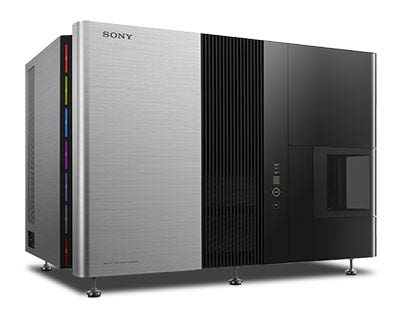
The ID7000™ Spectral Cell Analyzer
Precision Optics and Smart Unmixing
What really powers the ID7000 is its advanced optics, cleverly paired with proprietary noise-reducing technologies. These give the instrument its sharp sensitivity, so researchers can capture more nuanced and thorough data. The Weighted Least Squares Method (WLSM) fluorescence unmixing algorithm is the cherry on top, deftly unraveling complex spectral fingerprints for precise measurement of even the dimmest or rarest markers.
Ms. Cassels points out just how transformative this is for her lab: “The unmixing part can be really quite difficult for the users to wrap their heads around because it’s so different from what they’re used to. So, once we go through the unmixing and autofluorescence, I generally then tell them to try to go for it themselves, to just run some experiments.” By practicing with real datasets, users quickly move from uncertainty to mastery.
Ready for the Future: Spectral Sorting
As the field pushes forward, spectral sorting is set to become the new standard, and the ID7000 is built to ride that wave. Ms. Cassels notes that her facility is already eager to embrace these advancements, having witnessed their promise at recent conferences.
She predicts, “I think that spectral cell sorting will offer so much more information on our samples than we get with conventional cell sorting.” The ability to merge multiple panels into a few comprehensive ones is a real breakthrough, conserving both time and precious materials. This forward-focused philosophy keeps labs at the cutting edge, never held back by yesterday’s limitations.
Ms. Cassels’ journey shows that, while the transition to spectral technology may have its challenges, the rewards are undeniable. With the ID7000, researchers are equipped to peel back new layers of cellular biology, setting the stage for discoveries to come.
Watch the Full Video Interview
Class 1 Laser Product.
For Research Use Only. Not for use in diagnostic or therapeutic procedures.